SSO Agency · October 29, 2026
How to Audit SaaS Architecture Without Guesswork
A SaaS product can appear healthy right up to the moment growth exposes what the early architecture was hiding. A large customer asks for enterprise permissions. A sales campaign doubles traffic. A critical integration changes its API. Releases begin to feel risky, cloud spend rises without a clear reason, and the team starts treating manual workarounds as normal.
Knowing how to audit SaaS architecture gives leadership a way to replace assumptions with evidence. The purpose is not to produce a long catalog of technical flaws. It is to determine whether the technology foundation can support the next business objective, where operational and commercial risk sits, and which investments deserve attention first.
For a founder preparing to raise, a CTO inheriting an MVP, or an investor evaluating a product, the most useful audit connects architecture decisions to delivery speed, customer trust, margins, and expansion plans.
Start the audit with the business case
Architecture is only “good” in relation to what the business needs it to do. A system supporting 200 users and a product moving into regulated enterprise accounts face different requirements. Beginning with a generic checklist often creates noise because it treats every possible issue as equally urgent.
Set the audit scope around the next 12 to 24 months. Clarify the product roadmap, anticipated user and transaction growth, contractual commitments, target customer segments, required integrations, and any fundraising, acquisition, or geographic expansion plans. Also identify the events the business cannot tolerate: prolonged downtime, exposure of customer data, delayed billing, inaccurate reporting, or an inability to ship a promised feature.
This context creates a practical standard for the assessment. For example, a monolithic application is not automatically a problem. If it is understandable, tested, deployable, and capable of supporting the roadmap, splitting it into services may add cost and delivery risk. On the other hand, if one small change requires coordinating multiple teams and creates production instability, the structure may now be constraining growth.
How to audit SaaS architecture in five areas
A useful SaaS architecture audit moves from visible product behavior down to the systems, practices, and decisions behind it. The five areas below reveal most of the risks that matter commercially.
1. Map the real system, not the intended one
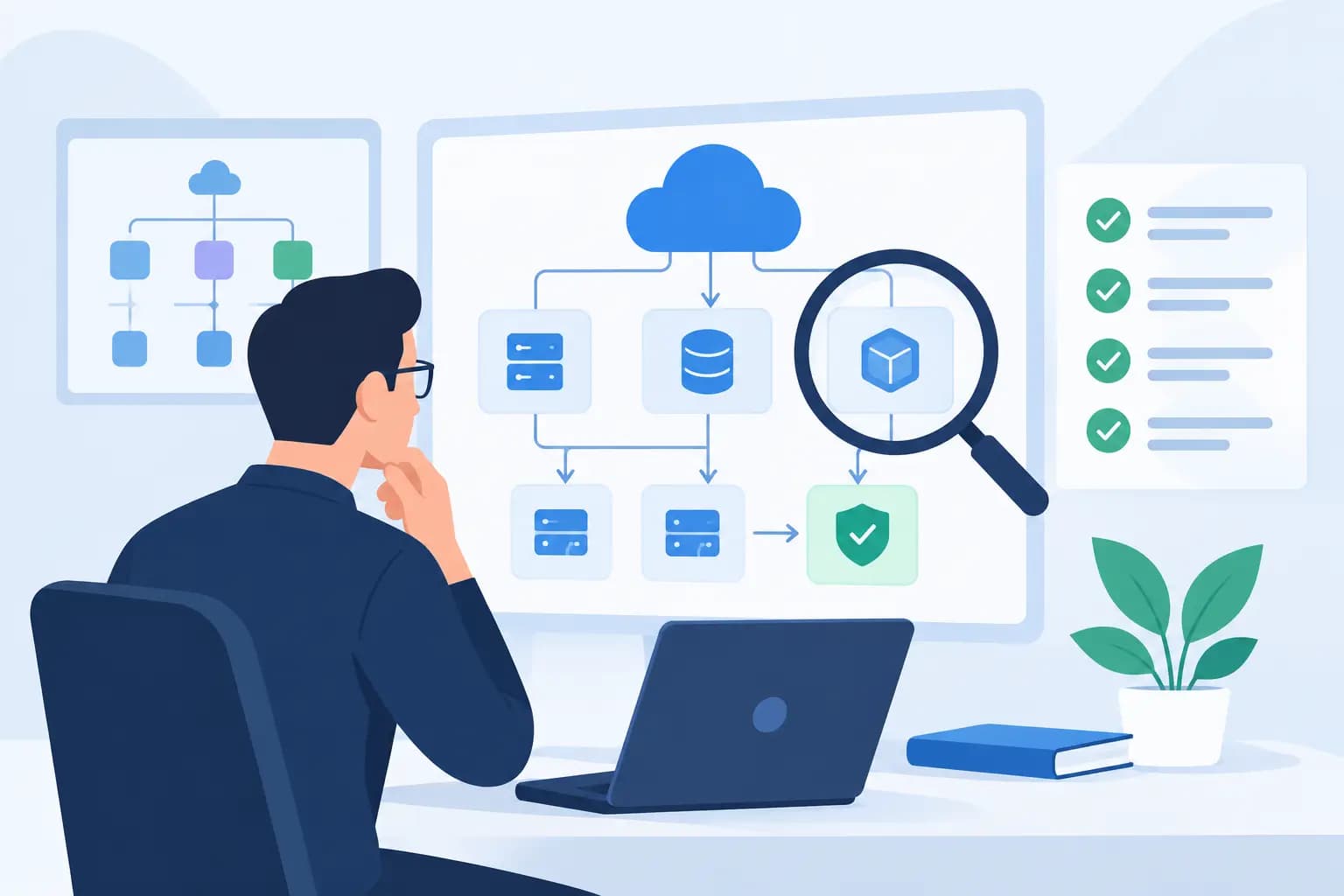
Start by documenting how requests, data, and dependencies actually move through the platform. This includes the frontend, backend services, databases, background jobs, cloud infrastructure, identity provider, third-party APIs, analytics tools, payment systems, and internal admin workflows.
Teams frequently have diagrams that are incomplete or outdated. The gap is meaningful. Undocumented scripts, shared databases, manually run jobs, and integrations owned by no one are common sources of outages and slow delivery.
Review the system boundaries and identify single points of failure. Ask what happens if a queue stops processing, a vendor API is unavailable, a database reaches capacity, or a deployment needs to be rolled back. The goal is not perfect redundancy everywhere. It is to understand which failures affect customers, revenue, and operations, then decide whether the current level of risk is acceptable.
2. Review scalability and performance under realistic load
Scalability is more than whether the application can handle more users. It includes database behavior, expensive queries, storage growth, background processing, rate limits, caching, network latency, and the ability to isolate demanding workloads.
Examine production metrics rather than relying only on opinions. Look for response-time trends, error rates, resource saturation, job backlogs, failed integrations, and usage spikes around known business events. If these signals are unavailable, that is itself a finding. A team cannot manage performance or capacity confidently when it lacks a clear view of production behavior.
Then test important assumptions. Can the system handle ten times current usage? Perhaps, but the more relevant question is whether it can handle the specific growth pattern expected next. A B2B platform may need to support a few very large accounts with complex permissions and high-volume data imports. A consumer-facing product may need to withstand sharp traffic peaks. Those are different architecture problems.
3. Assess security, access, and data handling
Security assessment should focus on the paths attackers, mistakes, and weak operational controls can realistically take. Review authentication, authorization, tenant isolation, secrets management, dependency patching, encryption, logging, backups, and incident response practices.
For multi-tenant SaaS products, authorization deserves particular scrutiny. It is not enough that users sign in securely. The application must consistently enforce what each user can view, change, export, or administer across every interface and API. Permission logic scattered through the codebase can become a serious risk as roles, customer requirements, and product modules expand.
Data handling also needs a business lens. Identify what data is collected, where it resides, who can access it, how long it is retained, and how it flows to vendors. A product may be technically functional while carrying unnecessary exposure through broad internal permissions, untracked exports, or production data used carelessly outside production.
The appropriate depth depends on your customers and obligations. A lightweight internal tool and an enterprise platform handling sensitive customer information should not receive the same level of control. What matters is making deliberate decisions and documenting the remaining risk.
4. Examine delivery practices and technical debt
Architecture cannot be separated from the way software is built and operated. A clean design on paper provides limited value if releases are manual, tests are unreliable, environments drift, and only one engineer understands the deployment process.
Review source control practices, code review, automated testing, continuous integration, deployment procedures, environment management, monitoring, alerting, and rollback capability. Also look at the flow of work: how long changes take from decision to production, how often releases cause rework, and where engineers lose time to repetitive maintenance.
Technical debt should be described precisely. “Legacy code” is not a useful finding on its own. State the mechanism and impact: for example, an outdated framework prevents security updates, a tightly coupled billing module makes pricing changes slow, or missing test coverage turns routine changes into production risk.
Not all debt should be repaid immediately. Some is a rational trade-off made to reach market quickly. The priority is debt that blocks revenue opportunities, raises operating cost, weakens reliability, or makes delivery increasingly unpredictable.
5. Analyze cost, vendor dependency, and operational ownership
Cloud and SaaS vendor spending can reveal architecture issues, but cutting spend is not always the right answer. Higher infrastructure cost may be justified by lower operational overhead, stronger reliability, or faster delivery. The audit should distinguish intentional spending from waste caused by oversized resources, abandoned environments, unbounded logs, inefficient queries, or poorly governed data retention.
Vendor dependency needs the same balanced approach. Third-party services can help a small team ship quickly. The question is whether critical dependencies have clear ownership, documented failure behavior, usage monitoring, and viable contingency plans. Replacing every vendor is rarely sensible. Depending blindly on a vendor for a core customer experience is equally risky.
Ownership is often the decisive issue. Every production system, integration, data pipeline, and recurring operational task should have a named owner and an understandable runbook. When ownership is ambiguous, incidents take longer to resolve and essential work falls between product, engineering, and operations.
Turn findings into decisions, not a backlog dump
The weakest audits produce a list of dozens of issues with no sequencing. That creates anxiety without improving execution. A stronger output groups findings by business impact, urgency, effort, and dependencies.
Separate immediate risk reduction from foundational improvements and roadmap-enabling work. An exposed secret, failing backups, or weak tenant isolation requires prompt action. Centralizing observability or improving deployment automation may be a near-term foundation. Reworking a domain boundary may be worthwhile only when a planned product expansion makes the limitation material.
Each recommendation should explain the trade-off in plain language: what problem it solves, what happens if it is deferred, what it will require, and how success will be measured. This lets executives make investment decisions without pretending every architectural choice has a simple yes-or-no answer.
The final roadmap should also account for delivery capacity. A small internal team may need to stabilize the platform while continuing to ship customer commitments. In that situation, a phased plan and senior execution support can be more effective than a disruptive rewrite. SSO Agency approaches assessments this way: turning technical findings into a practical roadmap that reduces risk while keeping the business moving.
A SaaS architecture audit is most valuable when it changes the next decision. If it clarifies what to fix now, what to monitor, what to defer, and what the product can confidently support next, it has done its job.