SSO Agency · August 20, 2026
How to Evaluate AI Vendors Without Creating Risk
A polished demo can make an AI vendor look like an obvious answer. The harder question is whether the product will improve a real workflow after it meets your data, systems, security requirements, and operating constraints. Knowing how to evaluate AI vendors means looking beyond model quality and deciding whether a provider can reduce work, support growth, and remain manageable after launch.
For founders, operations leaders, and product teams, the decision is rarely just about adding an AI feature. It may affect customer data, internal processes, vendor spend, engineering capacity, and accountability when results are wrong or incomplete. A useful evaluation creates clarity before the contract does.
Start With the Business Problem, Not the AI Category
Do not begin by asking which chatbot, agent, or model is best. Start with the bottleneck you need to remove. Perhaps customer support teams spend hours locating account context across disconnected systems. Maybe sales operations manually qualify leads, or analysts prepare recurring reports from inconsistent data sources.
Describe the current process in business terms: who performs it, how often it occurs, where decisions slow down, and what a better outcome would look like. The target might be reduced handling time, faster response to customers, fewer data-entry errors, improved conversion, or more capacity without proportional headcount growth.
This step prevents a common failure mode: buying a capable platform for a vague ambition, then asking employees to find a use for it. AI adoption has a cost even when the subscription price is modest. Teams must configure workflows, validate outputs, manage exceptions, train users, and maintain integrations. If the problem does not justify that effort, a simpler automation or process redesign may be the better investment.
A vendor should be able to discuss the workflow with you, not only present its product. If every issue is framed as a prompt-engineering problem, that is a signal the provider may not understand the operational environment it is entering.
How to Evaluate AI Vendors Against Real Requirements
A disciplined evaluation separates the decision into a few areas that can be tested. The weighting will depend on the use case. A marketing-content tool has a different risk profile from an AI system that summarizes patient records, routes financial requests, or recommends actions to customer support agents.
Business value and measurable use cases
Ask the vendor to connect its capabilities to a defined workflow and a measurable baseline. What manual steps will change? Which people will use the system? What does a successful result look like after 30, 60, or 90 days?
Be cautious with ROI projections that assume perfect adoption or ignore the cost of implementation. A credible vendor can explain where automation is reliable, where human review remains necessary, and how it handles edge cases. The goal is not to eliminate people from every process. It is to remove repetitive work while preserving judgment where it matters.
Data, security, and privacy controls
AI vendors may process sensitive customer, employee, financial, or proprietary information. Before sharing data, establish what enters the platform, where it is stored, how long it is retained, and whether it can be used to train shared models.
Security review should cover access controls, encryption, audit logs, incident response, authentication options, and administrative permissions. For regulated or enterprise-facing businesses, also consider data residency, subprocessors, contractual obligations, and the evidence the vendor can provide for its security practices.
A vendor does not need to have every certification on day one to be viable for every company. But it should answer direct questions clearly. Vague responses about “enterprise-grade security” are not enough when the tool will touch business-critical data.
Integration and technical fit
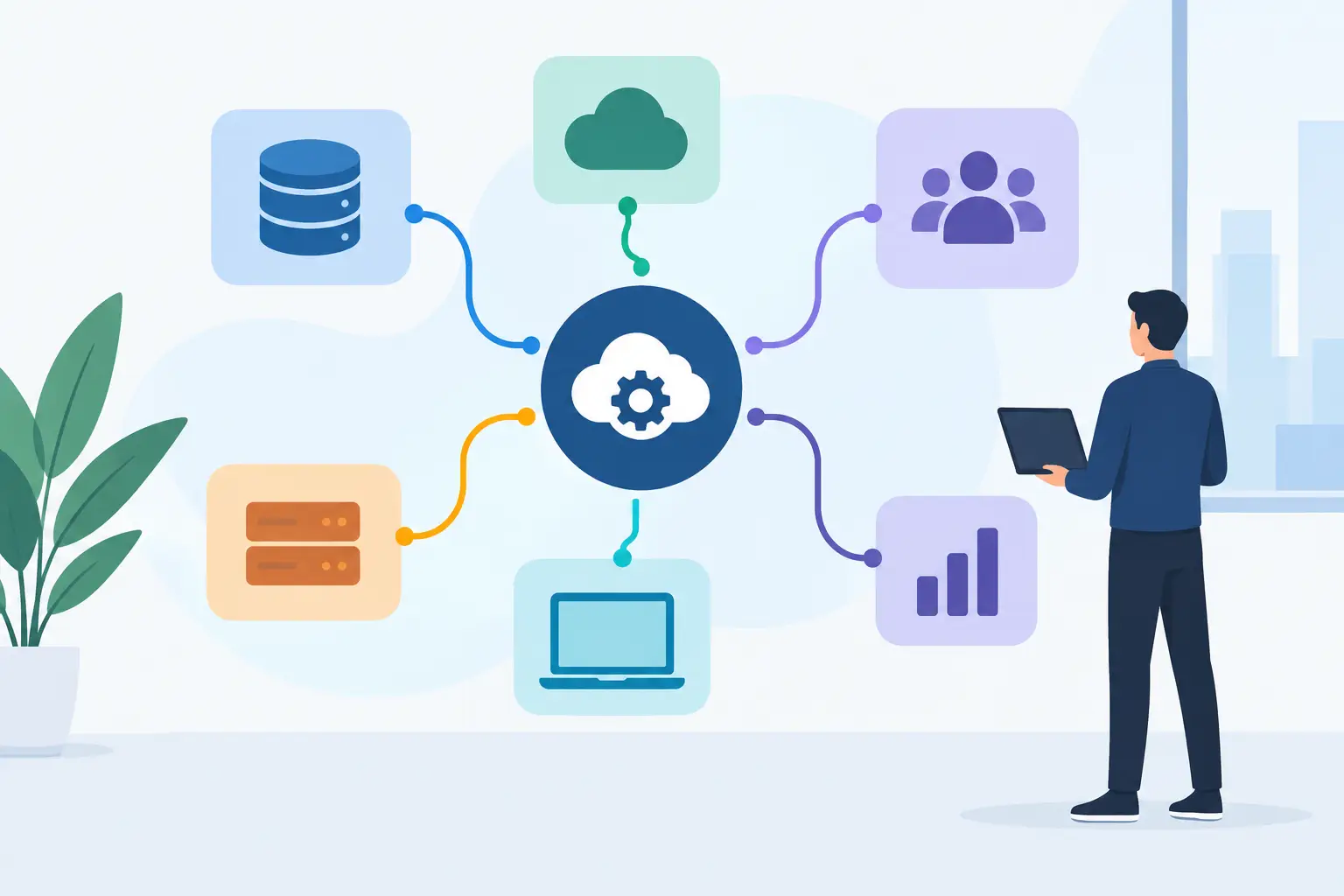
An AI tool that sits outside your core systems may create another manual handoff rather than remove one. Evaluate how it connects to the applications your team already relies on, such as CRM, help desk, ERP, data warehouse, identity provider, internal database, or custom platform.
Ask whether integrations are native, API-based, partner-built, or dependent on exports and uploads. Review API limits, webhook support, error handling, documentation, and the effort required from your engineering team. If the vendor claims it can integrate with anything, ask for the technical path, not the sales answer.
Also consider where the workflow logic should live. Some use cases belong in a specialized vendor platform. Others are better handled by a custom integration that combines your systems, business rules, and selected AI models. The right choice depends on differentiation, data sensitivity, required flexibility, and the long-term cost of ownership.
Output quality, reliability, and human oversight
AI systems can produce plausible but incorrect answers. Their quality can vary by input type, user behavior, model changes, and the quality of your underlying data. Testing should use representative examples from your actual workflow, including the difficult cases that a demo avoids.
Define acceptable performance before the pilot begins. For a document-classification workflow, this may mean accuracy and escalation rates. For an AI assistant, it may mean factual grounding, response quality, time saved, and how frequently users need to correct the output.
Ask how the vendor evaluates its system over time. Can it show source citations? Can you configure confidence thresholds? Does it support human approval before actions are taken? Can you audit what the system did and why? The more directly a tool affects customers, revenue, compliance, or operations, the more important these controls become.
Commercial model and long-term ownership
The initial price is only one part of the cost. Usage-based billing, model calls, implementation services, premium connectors, support tiers, and annual minimums can change the economics quickly as adoption grows.
Understand what happens if the vendor raises prices, changes a core model provider, deprecates a feature, or is acquired. Review data-export options, contractual exit terms, and the practical difficulty of moving the workflow elsewhere. Some dependency is normal. The concern is becoming dependent on a provider without access to your data, configuration, or operating knowledge.
Run a Pilot That Can Prove or Disprove the Case
A pilot should be a decision tool, not a prolonged demonstration. Choose one workflow with enough volume to produce useful evidence and enough boundaries to control risk. Assign an accountable business owner, a technical owner, and the users who will work with the tool daily.
Set a short timeline and document the baseline before the pilot starts. Measure the time, error rate, throughput, or customer impact of the current process. Then measure the same outcomes with the AI system in place. Qualitative feedback matters too, especially when adoption depends on whether the tool actually makes a team’s work easier.
The pilot should deliberately test failure conditions. Use incomplete inputs, conflicting instructions, unusual customer cases, permission boundaries, and system downtime scenarios. This is where implementation risk becomes visible. A vendor that helps your team investigate and resolve those issues is more valuable than one that only performs well on the happy path.
Avoid connecting a pilot to every system at once. Start with the minimum integration footprint required to validate value. If the results are promising, expand in stages with clear ownership, monitoring, and change-management plans.
Use a Scorecard to Keep the Decision Honest
When multiple stakeholders are involved, a weighted scorecard prevents the loudest voice or best demo from determining the outcome. Rate each vendor against the same criteria and document the evidence behind each score.
A practical scorecard usually includes:
- Business impact and fit for the prioritized workflow
- Security, privacy, and compliance alignment
- Integration effort and compatibility with existing systems
- Quality, transparency, and controls around AI outputs
- Total cost over the expected adoption period
- Vendor maturity, support model, and exit risk
Not every category deserves equal weight. A startup testing internal productivity tools may prioritize speed and cost. An investor evaluating a company whose product relies on a third-party model may put more emphasis on concentration risk, architecture, and contractual protections. Make those trade-offs explicit rather than treating every vendor requirement as equally important.
Assess the Vendor as an Operating Partner
The technology matters, but the vendor relationship matters too. You are evaluating how the company responds when something breaks, a model behavior changes, or your team needs a workflow adapted to fit reality.
Ask who will support implementation, whether you will have access to technical specialists, how product changes are communicated, and what service commitments apply. Request a clear division of responsibilities. The vendor may own the platform, but your organization still needs someone accountable for process design, data quality, permissions, user adoption, and performance review.
This is also where reference conversations can be useful. Speak with customers that resemble your organization in size, industry, and use case. Ask what took longer than expected, what internal work was required, and what they would do differently. The most useful references describe constraints as well as successes.
Make the Decision With an Execution Roadmap
Selecting a vendor is not the finish line. Before signing, create a practical roadmap for implementation, governance, adoption, and review. Define the first workflow, integration sequence, data-access rules, success measures, escalation process, and named owners.
If the evaluation exposes fragmented data, weak permissions, or a brittle integration layer, address those constraints directly. They may be the real barrier to getting value from AI. In some cases, the best next step is not vendor selection at all. It is strengthening the technology foundation so the eventual AI investment can perform as intended.
SSO Agency approaches AI decisions this way: as a business and technology assessment that leads to clear action, whether that means selecting a platform, building a tailored workflow, or fixing the systems around it first. The strongest vendor choice is the one your team can implement, govern, and improve without introducing unnecessary operational risk.