SSO Agency · November 26, 2026
Architecture Assessment Example: Risk to Roadmap
A promising product can still be one deployment, integration, or enterprise security review away from a serious delay. This architecture assessment example shows what a useful assessment looks like when the goal is not to produce a technical report for its own sake, but to make clearer business decisions about growth, risk, and engineering investment.
For founders, product leaders, and investors, the central question is rarely whether the code is perfect. It is whether the current technology foundation can support the next business objective: a larger customer, a new product line, a fundraise, an acquisition, or a faster operating model. A strong assessment answers that question directly, with evidence and a practical sequence of work.
What an Architecture Assessment Should Produce
An architecture assessment evaluates how a software product is built, operated, secured, and changed. It examines the technical design, but it also considers the delivery process behind that design. A platform may have sound infrastructure and still carry substantial execution risk if releases depend on one person, testing is inconsistent, or key decisions exist only in Slack messages.
The output should not be a long catalog of issues without context. Decision-makers need three things: a clear view of material risks, the likely business impact if those risks are left unresolved, and a prioritized roadmap that separates urgent stabilization work from longer-term improvements.
That distinction matters. Not every legacy dependency needs immediate replacement. Not every monolithic application needs to become a collection of services. Architecture decisions should follow the product's actual demands, team capacity, budget, and time horizon. The right recommendation reduces risk without creating unnecessary complexity.
Architecture Assessment Example: A Growth-Stage SaaS Platform
Consider an illustrative B2B SaaS company preparing to sell into larger accounts. Its product has grown quickly from an MVP into a platform used by several hundred customers. The company now needs stronger reliability, role-based access controls, auditability, and a faster way to deliver integrations requested by prospective enterprise clients.
The assessment begins with a business context session. The technical team is asked to explain the platform, but executives also define the commercial stakes: which deals depend on enterprise readiness, what product capabilities are planned over the next two quarters, where operations teams still rely on manual work, and what downtime or security concerns would create the greatest exposure.
Reviewers then inspect the application architecture, source repositories, cloud configuration, deployment process, production observability, database design, third-party dependencies, security controls, and engineering workflow. Interviews with developers, product owners, and operations stakeholders add the context that diagrams alone cannot provide.
The Current-State Snapshot
In this example, the assessment finds a practical but increasingly strained setup. The application is a single web platform with a shared relational database. It has served the company well because the small team can ship features quickly. However, customer onboarding, billing synchronization, and reporting now run through scheduled background jobs that share limited worker capacity.
Deployments are mostly automated, but production changes are not consistently reviewed or linked to a release checklist. Monitoring alerts report system failures, yet they do not reliably show whether key customer workflows, such as data imports or invoice generation, are completing successfully. Administrators have broad access to production data because permissions were added informally as the team expanded.
None of these findings automatically means the platform needs a rewrite. The architecture is not failing because it is a monolith. The issue is that the operating model around it has not kept pace with the company's market opportunity.
Sample Findings and Business Implications
A useful report translates each finding into a decision. The following is a condensed example of how that might appear.
| Finding | Technical implication | Business implication | Priority | | --- | --- | --- | --- | | Background jobs share one worker queue | Heavy imports can delay billing and notifications | Customer-facing delays become more likely as usage grows | High | | Production access is broadly assigned | Sensitive actions are difficult to audit or constrain | Enterprise security reviews may take longer and create avoidable concern | High | | No automated restore test for the primary database | Backups may exist without proof of recoverability | A data incident could create a longer, less predictable outage | High | | Integration logic is embedded across the application | New connectors require changes in multiple areas | Partnership and customer-requested integrations are slower to ship | Medium | | Test coverage favors unit tests over key workflows | Release defects can reach critical user journeys | Engineering confidence declines as release frequency increases | Medium |
The priority reflects more than technical severity. A database restore test is often straightforward to implement, but its impact on operational resilience is significant. By contrast, redesigning all integration code may be valuable, but it should be sequenced around immediate revenue opportunities and the team's capacity to change it safely.
How the Roadmap Turns Findings Into Action
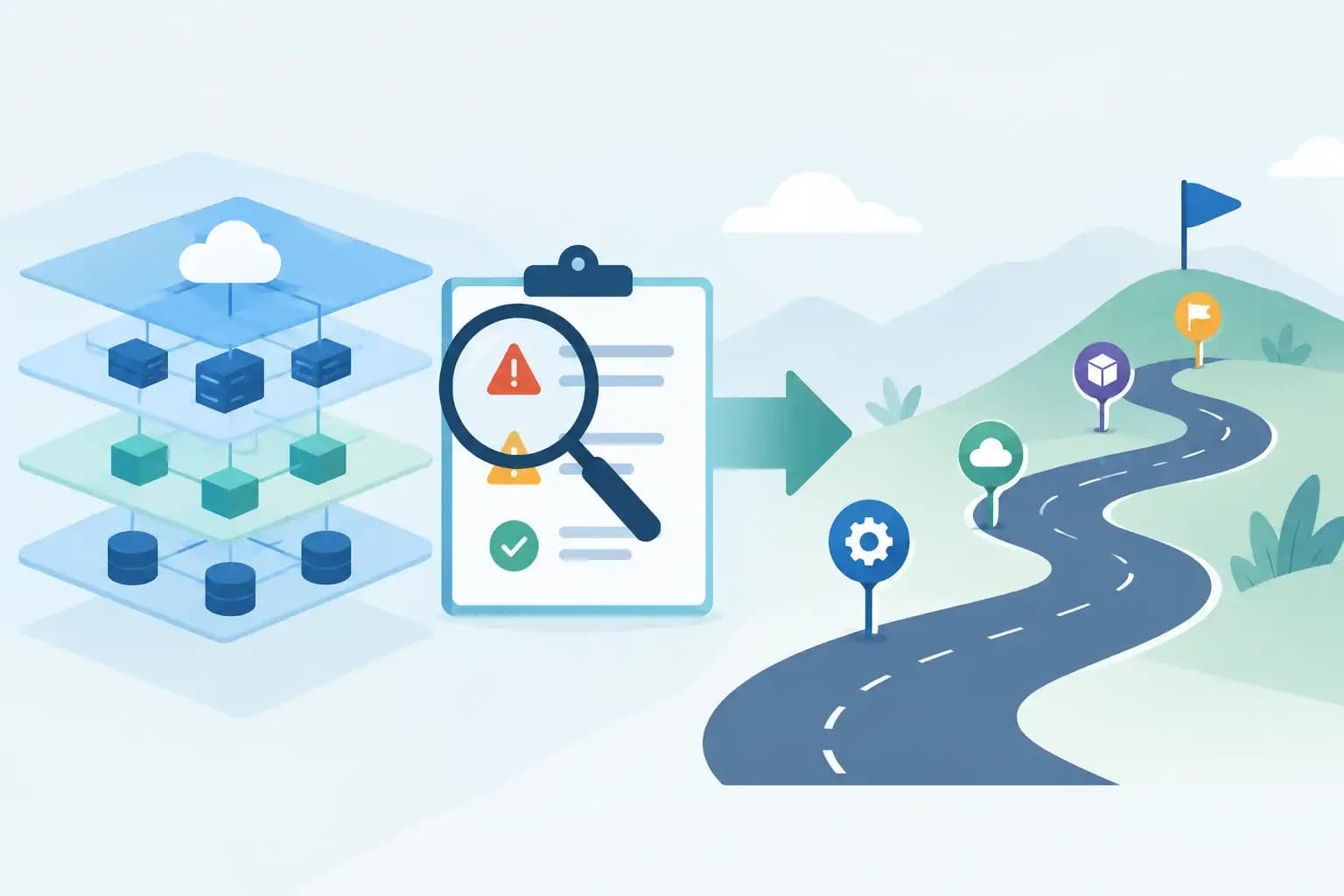
The most useful part of an assessment is the execution roadmap. It should identify what to address now, what to plan, and what to monitor. It should also make dependencies visible. For example, improving access controls may require a clearer inventory of administrative functions before permissions can be redesigned.
For this platform, a 90-day roadmap could begin with stabilization. The team separates critical background workloads into dedicated queues, adds workflow-level monitoring for onboarding and billing, validates backup restoration in a non-production environment, and establishes a lightweight production access review. These are focused changes that reduce operational and security risk without slowing product delivery for months.
The next phase strengthens delivery. Engineers add automated checks for the highest-value customer workflows, standardize release documentation, and define ownership for alerts and incidents. This is not process for process's sake. It reduces the chance that product growth depends on tribal knowledge or late-night troubleshooting.
The third phase improves extensibility where business demand justifies it. Rather than splitting the entire application into microservices, the team defines a consistent integration boundary and moves the most frequently changed connector logic behind it. This creates a path to ship new integrations faster while keeping the core product stable.
What Evidence Makes an Assessment Credible
Recommendations carry more weight when they are traceable to evidence. A high-quality assessment does not rely on generic statements such as “improve scalability” or “modernize the stack.” It explains the condition observed, the risk created, and the reasonable options available.
For example, a recommendation to introduce event-driven processing should identify which workflows are currently coupled, what volume or reliability problem exists, and whether the organization can operate the additional infrastructure. Sometimes a simpler queued job with retries and better observability is the better first step. The answer depends on the real bottleneck, not the appeal of a particular pattern.
The assessment should also identify what was not reviewed. If penetration testing, load testing, or vendor contract review sits outside the scope, that limitation should be stated plainly. Clear boundaries build trust and help leaders commission the next piece of work only when it is warranted.
Common Mistakes to Avoid
The first mistake is treating an assessment as a grading exercise. A red-yellow-green scorecard can be useful, but it does not replace judgment. Two organizations may receive the same rating for weak observability, while one needs immediate work because it supports a regulated enterprise workflow and the other can safely prioritize product discovery first.
The second is recommending a wholesale rebuild without proving that incremental improvement cannot meet the business need. Rebuilds can be justified when the platform is fundamentally constrained, but they introduce migration risk, opportunity cost, and a long period where teams may be maintaining two systems. A staged modernization plan is often the more responsible choice.
The third is separating technical risk from commercial planning. If a major customer needs single sign-on, audit logs, and a new integration within one quarter, the roadmap must account for that deadline. Technical priorities should help leaders protect revenue, accelerate delivery, and make credible commitments.
From Assessment to Better Decisions
An assessment creates value when it gives leadership enough clarity to act. That may mean approving a focused reliability initiative, delaying a costly replatforming project, strengthening the engineering team with senior capability, or deciding that a product is ready for the next stage of growth.
At SSO Agency, the work is designed to turn technical findings into business decisions and an execution plan the team can actually ship. The best next step is rarely to fix everything. It is to identify the few changes that materially reduce risk now, establish ownership, and build a technology foundation that supports the opportunity in front of the business.