SSO Agency · November 18, 2026
A Software Modernization Example That Scales
A software modernization example is most useful when it shows more than a technology replacement. It should show how a company removes a business constraint: slow product releases, manual operations, unreliable reporting, or a platform that cannot support the next stage of growth.
Consider a growth-stage B2B software company with a profitable product, an established customer base, and a development team that is constantly busy. Its core application was built quickly several years earlier. The original architecture worked when the company had one product line, a limited number of integrations, and a small operations team. Now it supports enterprise customers, multiple workflows, and a growing volume of data.
The problem is not that the system is old. The problem is that every meaningful change has become expensive, risky, and difficult to estimate.
A Software Modernization Example: The Starting Point
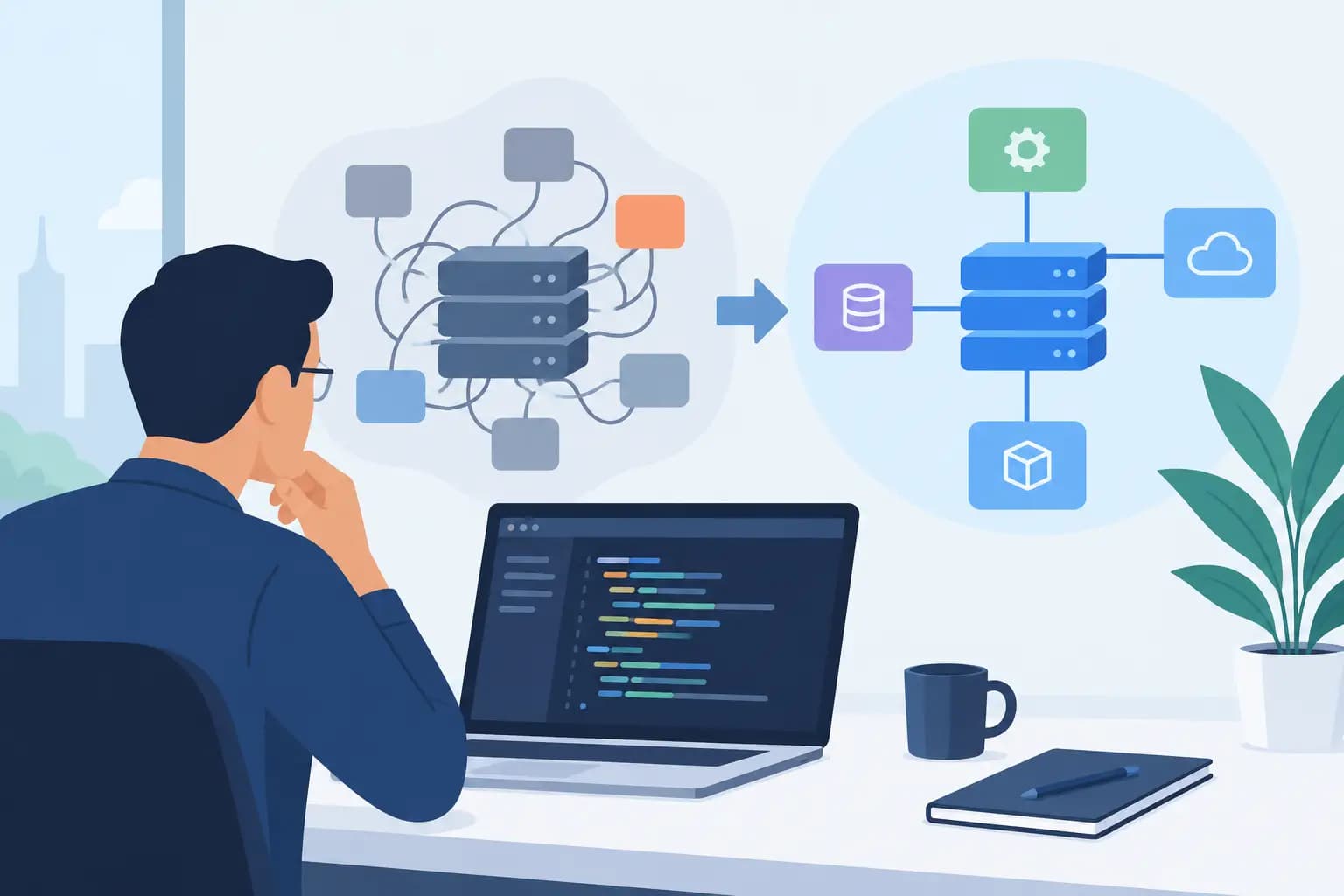
In this scenario, the company’s platform is a tightly coupled application. Customer data, billing logic, reporting, user permissions, and integrations all sit in the same codebase. Deployments require careful coordination because a change to one area can unexpectedly affect another. Engineers spend a disproportionate amount of time investigating defects, handling support escalations, and maintaining one-off integration code.
Operations has adapted around the software rather than through it. Team members export data into spreadsheets, reconcile records manually, and move information between the CRM, billing system, support platform, and internal tools. Leadership receives reports, but confidence in the numbers is low because each department calculates key metrics differently.
These conditions create commercial consequences. Product launches slip because delivery estimates are uncertain. Enterprise sales commitments introduce technical risk. Operations costs rise with customer volume. Fundraising or acquisition discussions become harder when technical debt is visible but poorly understood.
A modernization effort should not begin with a broad instruction to “rewrite the platform.” A full rewrite can delay value, consume engineering capacity, and recreate existing problems in a newer stack. The first step is to identify which constraints are damaging the business now and which parts of the system must change to remove them.
Define the Business Case Before Choosing Technology
The company begins with a technical and operational assessment. This is not simply an inventory of outdated frameworks. The work connects system behavior to business objectives.
For example, the assessment may find that the most significant bottleneck is not the customer-facing interface. It is an order-processing workflow buried inside the monolith. That workflow has accumulated special rules for individual customers, relies on scheduled batch jobs, and passes incomplete data to the billing platform. It takes operations staff hours each day to resolve exceptions.
This finding changes the modernization plan. Rebuilding the interface may improve appearance, but it will not remove the daily bottleneck. Replacing the workflow with a well-defined service, clear data contracts, and reliable integrations can improve processing speed, reduce manual intervention, and make future product changes easier to ship.
At this stage, leaders need clear decisions on three questions:
- Which technical constraints have the greatest effect on revenue, cost, customer experience, or execution risk?
- What can be modernized incrementally without interrupting the product or overloading the internal team?
- What foundation needs to be put in place so new complexity does not recreate the same problem?
The answers will differ by company. A startup preparing for rapid product expansion may prioritize modular architecture and delivery speed. An established business with high-volume back-office work may prioritize workflow automation, data quality, and system reliability. An investor evaluating an acquisition may first need an independent view of security, maintainability, and the realistic cost of the technical roadmap.
The Modernization Plan: Replace the Constraint, Not Everything
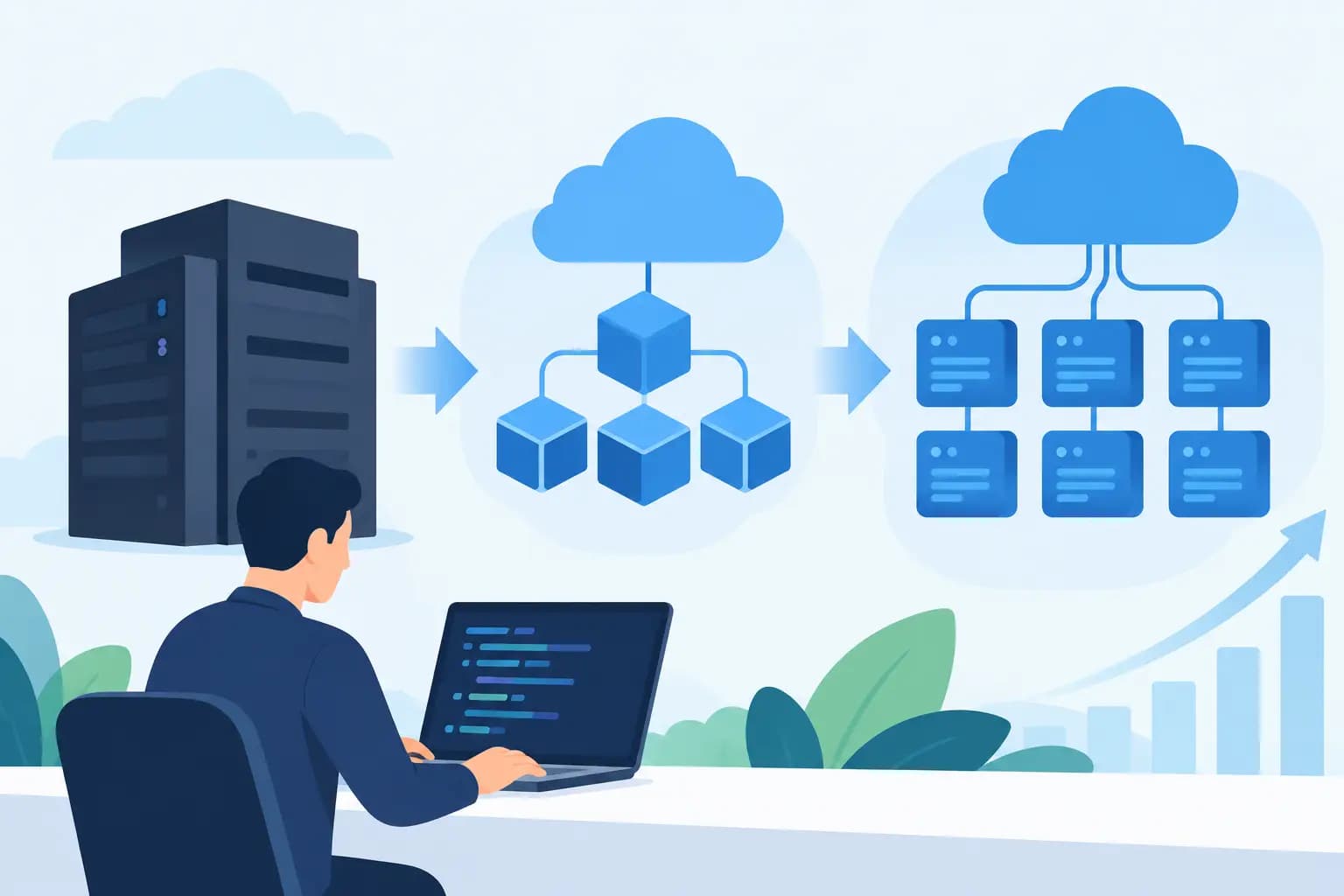
In this software modernization example, the company chooses a phased approach. It does not attempt to decompose the entire monolith at once. Instead, it creates a clear boundary around order processing and builds a new service for that domain.
The new service receives validated order events, applies standardized business rules, and sends reliable updates to billing, fulfillment, and the customer platform. Rather than allowing each integration to write directly into the core database, the team establishes controlled interfaces. This reduces accidental dependencies and makes failures easier to identify.
The legacy application remains in place during the transition. New orders are progressively routed through the modern workflow while the old process continues to handle exceptions or lower-priority customer segments. This parallel period adds short-term complexity, but it reduces the risk of a disruptive cutover.
A practical plan also includes the less visible work that determines whether modernization holds up over time: automated testing for critical workflows, deployment pipelines, monitoring, access controls, documentation, and ownership rules. A modern service without observability or reliable deployment practices can become another isolated source of risk.
Build a trustworthy data foundation
Data is often where modernization efforts succeed or fail. If customer, order, and billing data are defined differently across systems, automating the workflow only accelerates inconsistency.
The team therefore establishes a shared definition for the records that matter. It documents the source of truth for each field, how updates are propagated, and what happens when systems disagree. This may sound administrative, but it has direct operational value. Finance, customer success, and product teams can work from the same information instead of reconciling separate exports.
The goal is not a perfect enterprise data model on day one. The goal is to make the highest-value workflow reliable and to create standards that can be extended as other components are modernized.
Use AI where it improves a defined workflow
AI can support modernization, but it should not become the center of the program without a clear operating need. In this scenario, an AI-enabled internal tool could help operations staff classify incoming exceptions, summarize account history, or draft a recommended next action based on approved system data.
That is different from placing a general chatbot over an unreliable process. If the underlying records are incomplete or permissions are poorly designed, AI can amplify confusion rather than remove it. The right implementation includes clear user controls, appropriate data access, testing, and an escalation path for decisions that still require human review.
For companies evaluating these opportunities, the useful question is simple: does this capability remove a repeated bottleneck while remaining secure and maintainable? If not, it may be better to first strengthen the workflow and data foundation.
What Changes After the First Release
The first modernization release does not make the legacy platform disappear. It changes the company’s ability to operate and improve it.
Order exceptions become visible in one place rather than being discovered through email threads and spreadsheets. The operations team can see why an item failed and resolve it using consistent rules. Engineering can deploy changes to the new workflow without retesting unrelated parts of the monolith. Product leaders have a more realistic path for adding new order types, pricing logic, or partner integrations.
Just as important, the company has created a repeatable pattern. The next candidate for modernization might be reporting, permissions, customer onboarding, or a high-maintenance integration. Each decision can be evaluated against the same criteria: business impact, technical risk, dependency complexity, implementation effort, and long-term ownership.
This is where many organizations gain momentum. They stop treating technical debt as an abstract backlog and start managing it as a portfolio of business decisions.
Trade-Offs Leaders Should Expect
Modernization is an investment in reducing future friction, not a way to avoid all complexity. During a phased transition, teams may need to support both old and new workflows. There may be temporary integration work that will later be retired. Some features should wait until core data and process issues are resolved.
There is also a staffing trade-off. Internal teams often know the product deeply but may not have enough capacity to assess architecture, redesign critical workflows, and continue feature delivery at the same pace. Adding senior external capability can help, but only when that team is accountable for understanding the business context and leaving behind maintainable systems, not just shipping isolated tickets.
The most common mistake is prioritizing technical elegance over the actual constraint. A new framework, cloud migration, or service architecture may be appropriate, but it is not automatically the best first move. The sequence matters. Modernize the parts that reduce material operational risk or create a clear path to growth, then build from there.
SSO Agency approaches this work by connecting technical findings to an execution roadmap: what to stabilize, what to rebuild, what to automate, and what can wait. That gives executives a practical basis for funding and sequencing the work while giving engineering teams a plan they can execute.
The right first modernization project should create more than cleaner code. It should give the business one less reason to hesitate when the next customer, product opportunity, or growth milestone arrives.