SSO Agency · November 10, 2026
What Causes Fragile Architecture as You Scale?
A feature that takes two days in one part of the product and breaks an unrelated workflow is not merely an engineering inconvenience. It is a business signal. When leaders ask what causes fragile architecture, they are usually seeing the consequences already: delayed releases, growing support load, expensive workarounds, unreliable reporting, and a team that is increasingly afraid to change the system.
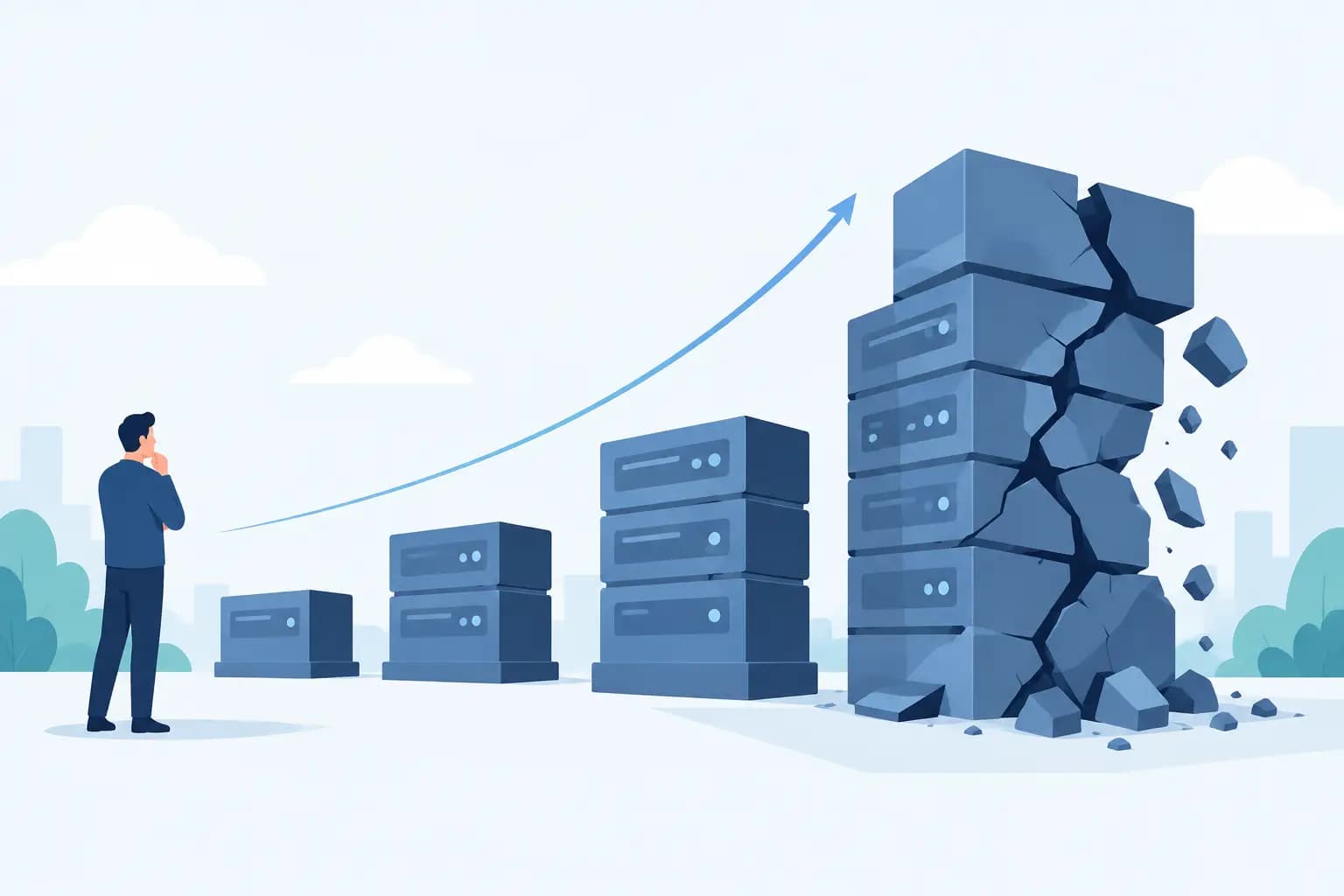
Fragility is rarely caused by one bad technical decision. It develops when reasonable short-term choices accumulate without a clear plan for how the product, team, and operating model need to evolve. The result is software that may still work under normal conditions but becomes difficult to modify, test, secure, or scale.
For growth-stage companies, the practical question is not whether the architecture is perfect. It is whether it supports the next meaningful stage of the business without forcing disproportionate cost, risk, or delay.
What Causes Fragile Architecture?
Fragile architecture emerges when critical parts of a system have too many hidden dependencies, unclear responsibilities, or unsupported assumptions. A change in one area creates unintended effects elsewhere because the system's boundaries are weak or poorly understood.
The original decision may have been sensible. A startup may use a shared database, a single application codebase, manual operations, or tightly coupled integrations to get an MVP into customers' hands. Those choices can reduce time to market. They become a problem only when the business outgrows them and no one adjusts the technical foundation.
Architecture also becomes fragile when teams treat delivery speed and engineering discipline as opposing goals. They are not. The right level of discipline protects delivery speed by making change more predictable. The mistake is adding complexity before it is needed or, just as damaging, postponing necessary structural work until every release becomes high risk.
The Common Sources of Architectural Fragility
Tightly coupled components
Coupling is not inherently bad. Every system has components that need to communicate. The risk rises when a product feature, business rule, database structure, and third-party integration are all embedded in the same area of code. A small adjustment then requires changes across multiple layers, often by people who do not fully understand the consequences.
A common example is an application where several services write directly to the same database tables. It feels efficient initially. Over time, teams cannot change a data model without coordinating unrelated systems, and ownership becomes unclear. The database becomes an unplanned integration layer rather than a protected source of truth.
The answer is not automatically microservices. Splitting a modest product into many independently deployed services can introduce its own operational burden. Clear module boundaries, controlled interfaces, and deliberate data ownership often solve the immediate problem with less complexity.
Business logic scattered across the stack
When pricing rules live partly in application code, partly in automation tools, partly in a CRM workflow, and partly in spreadsheets, the system may produce correct results until a rule changes. Then the organization has to find every version of the logic, determine which one is authoritative, and hope nothing was missed.
This pattern often appears as companies add integrations and automation around an existing product. The automation delivers real value, but only if it is designed as part of an operating system rather than as a collection of isolated fixes. Critical decisions need an identifiable owner, a documented source of truth, and a controlled way to change them.
Weak data contracts and integration design
Many fragile systems are held together by integrations that were built quickly and never made observable. Fields change names, records arrive out of order, APIs fail intermittently, or duplicate events are processed without clear recovery behavior. The issue may not surface immediately. It appears later as inaccurate reporting, missed customer actions, or operations teams manually reconciling data.
A dependable integration defines what data is exchanged, who owns it, how failures are handled, and how teams can see that it is working. Retries, idempotency, error queues, and audit trails may sound like implementation details, but they reduce operational risk when systems inevitably fail or change.
Missing test coverage around critical behavior
A system does not need exhaustive tests for every line of code. It does need confidence around the workflows that affect revenue, customer access, billing, permissions, core data, and key integrations. Without that confidence, each release becomes a manual investigation.
Fragility increases when testing depends on a few individuals who know where the problems usually occur. That knowledge is valuable, but it is not a scalable control. Automated tests, realistic test environments, and release checks turn critical knowledge into a repeatable delivery process.
Infrastructure that cannot be reproduced
Configuration performed manually in production is another frequent source of instability. If a deployment, environment setting, access permission, or database change exists only because someone made it work once, the system is hard to recover, audit, or safely extend.
This does not require an oversized platform engineering program. It requires a practical baseline: version-controlled configuration where feasible, repeatable deployments, protected secrets, visibility into failures, and a clear process for changing production systems. The appropriate level depends on the product's risk profile, customer commitments, and rate of change.
Process Problems Can Make Sound Technology Fragile
Architecture is shaped by how decisions are made. A capable codebase can become brittle if every urgent request bypasses product and technical prioritization. Conversely, a team can stabilize imperfect technology when it has clear ownership and a consistent way to improve high-risk areas.
The most damaging process pattern is permanent urgency. When every request is treated as exceptional, teams optimize for local speed. They copy an existing pattern rather than assess whether it still fits, hard-code a rule rather than model it properly, or add another integration without defining operational ownership.
Unclear decision rights have a similar effect. If no one can decide when to refactor, retire a workaround, or reject a risky shortcut, technical debt remains visible but unmanaged. It accumulates interest through slower delivery, more incidents, and greater dependence on a small group of people.
This is why architecture assessment should not end with a list of code issues. Leaders need a prioritized execution roadmap that connects each finding to business impact. Which changes reduce release risk? Which ones unblock a product expansion? Which bottlenecks consume operations time? Which security gaps need immediate attention? Those are investment decisions, not just engineering preferences.
Warning Signs Leaders Should Not Ignore
Fragile architecture is often recognizable before a major failure. Releases require late-night coordination because no one is confident about downstream effects. A few engineers become gatekeepers for every meaningful change. Teams avoid upgrading dependencies or infrastructure because the effort feels unpredictable. Customer-facing issues are diagnosed through manual database checks and private knowledge rather than monitoring and documented workflows.
Another signal is that the organization cannot answer simple operational questions quickly: Which system owns this customer field? What happens if this vendor API is unavailable? Which service sent this message? Can we reproduce this issue outside production? Uncertainty in these areas creates avoidable risk as transaction volume, product scope, and team size increase.
None of these signals automatically means a full rebuild is necessary. Rewrites are expensive, disruptive, and sometimes repeat the same mistakes in a newer codebase. In many cases, the better path is targeted modernization: isolate a high-change module, replace an unstable integration, establish observability, strengthen deployment controls, or consolidate duplicated business logic.
How to Strengthen the Foundation Without Stalling Delivery
Start with the business capabilities that matter over the next 12 to 18 months. A planned enterprise integration, new customer segment, AI-enabled workflow, international expansion, or fundraising process changes what the architecture must support. The goal is not abstract scalability. It is fitness for the roadmap.
Then map the critical paths behind those capabilities. Identify the systems involved, the data they exchange, the people who own them, their dependencies, and the failure modes that would interrupt operations. This usually reveals where a modest engineering investment can remove a disproportionate amount of risk.
Prioritize work in three categories: immediate controls for material risk, focused improvements that make delivery more predictable, and larger architectural changes justified by a clear product or operating need. Keep the plan active. Architecture is not a one-time project completed in a planning document. It is a set of decisions that should be revisited as the company grows.
SSO Agency approaches this work by translating technical findings into business decisions, then helping teams move from assessment to implementation. The objective is not to introduce complexity for its own sake. It is to strengthen the technology foundation so the company can ship with more confidence and scale without unnecessary overhead.
A fragile architecture is not a verdict on the team that built it. It is evidence that the business has changed faster than parts of the system were designed to support. Treat it as a clear signal to make deliberate choices now, while the available options are still broad.