SSO Agency · September 7, 2026
Low Code Versus Custom Software for Growth Teams
A team needs a customer portal before a major renewal, an operations workflow is consuming hours every week, or a product roadmap is blocked by systems that do not share data. In those moments, low code versus custom software is not an abstract technology debate. It is a decision about how quickly you can move, what risk you accept, and whether the solution will still support the business a year from now.
Low-code platforms can deliver useful internal tools and workflow automation quickly. Custom software can create the control, differentiation, and integration depth that a growing company eventually needs. The right answer depends less on the platform’s feature list and more on the job the software must do.
Start with the business constraint, not the build method
The wrong starting question is, “Can we build this in low code?” Most ideas can be forced into a low-code tool with enough workarounds. The better question is, “What business problem must this solve, and what happens when the process, product, or customer base grows?”
If the priority is removing a contained manual bottleneck, a low-code solution may be the responsible choice. Consider an internal request workflow, a lightweight approval process, a sales operations dashboard, or an alerting system that connects well-defined data sources. These projects often benefit from speed more than from deep architectural control.
If the software is central to how you serve customers, generate revenue, manage sensitive data, or differentiate your product, custom development deserves more scrutiny. A customer-facing platform, a core pricing engine, a complex marketplace, or a workflow with unusual business rules can become expensive and fragile when it is constrained by a platform’s assumptions.
A useful distinction is simple: low code is often effective for accelerating a known process. Custom software is usually the stronger investment when the process itself is a strategic capability that needs to evolve.
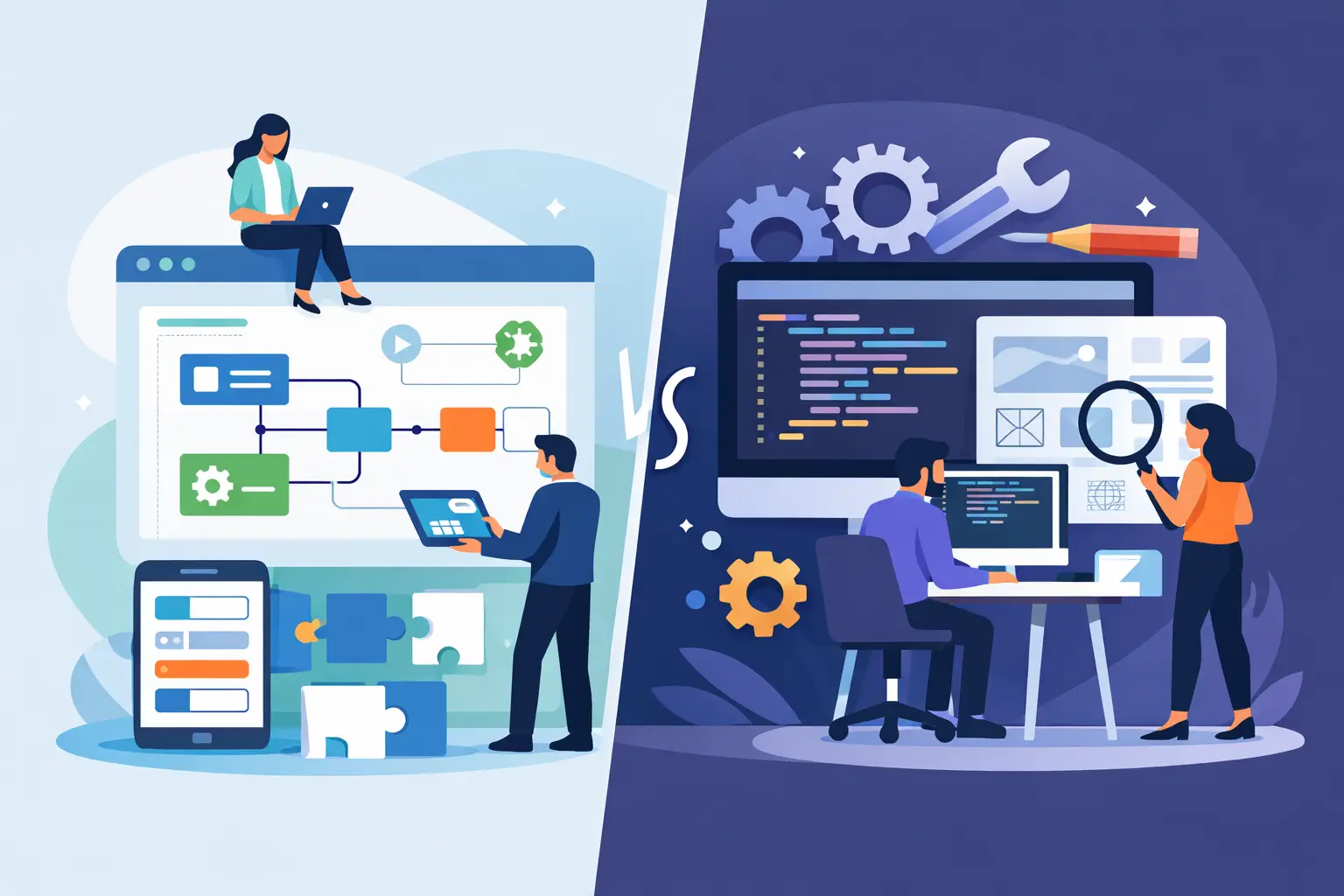
Low code versus custom software: the real trade-offs
Low code does not mean no engineering. Custom software does not automatically mean slow delivery. Both approaches require clear requirements, sound data decisions, testing, security review, ownership, and a plan for change.
The difference is where the constraints sit. With low code, the platform provides prebuilt components, workflow logic, hosting, and integrations. That reduces the amount of code your team must write, but it also means your solution operates within the platform’s limits. With custom software, your team owns more of the design and implementation. That creates more flexibility, along with more responsibility.
Speed is valuable, but only when it solves the right problem
A low-code platform can shorten the path from idea to a working internal tool. For a time-sensitive pilot, that may be exactly what the business needs. Teams can validate whether a workflow should exist before committing to a larger build.
The risk appears when a quick tool quietly becomes business-critical. A prototype may gain more users, more exceptions, new data sources, and external customer access. What began as an operational shortcut can turn into a core system without the architecture, security controls, or support model required for that role.
Custom software typically takes longer to define and build at the beginning. But for complex use cases, it can avoid the compounding delays created by platform workarounds, disconnected integrations, and manual exception handling. The goal is not to build more than necessary. It is to build enough of the right foundation to ship confidently and extend it without repeated rework.
Initial cost is not the same as total cost
Low-code tools can reduce upfront engineering effort. That is a meaningful advantage, particularly for a small team with an urgent operational need. But license costs, premium connectors, usage-based pricing, external implementation support, and ongoing administration can change the economics as adoption rises.
Custom software requires a larger initial investment because discovery, architecture, development, quality assurance, and deployment must be handled deliberately. Yet it may have a lower long-term cost when it consolidates fragmented tools, removes recurring manual work, or supports a revenue-generating product without per-user platform constraints.
The financial question is not simply, “Which option costs less this quarter?” It is, “Which option gives us an acceptable cost structure at the scale we are planning for?” A credible business case includes build cost, licensing, maintenance, internal ownership, integration effort, security requirements, and the cost of operational failure.
Control matters most around core workflows and data
Low-code platforms vary widely in their security capabilities, data residency options, audit trails, identity controls, and API flexibility. A tool may be suitable for internal task coordination but inappropriate for customer data, financial operations, healthcare information, or a workflow with strict contractual obligations.
Custom software gives an organization more control over architecture, authorization, data models, integrations, and deployment. That does not remove risk. It makes the organization responsible for managing it. The benefit is that security and compliance requirements can be designed into the solution rather than added as compromises after the fact.
For established growth companies, investors, and acquirers, this distinction also affects diligence. A business that depends on undocumented low-code workflows, personal administrator accounts, or brittle integrations carries operational risk that may not be visible until a key employee leaves or a platform changes its pricing and product direction.
Flexibility has a maintenance cost
Custom software can support unique workflows because it is designed around them. It can also become difficult to maintain when requirements are poorly defined, code quality is inconsistent, or ownership is unclear. Building custom is not a license to create unnecessary complexity.
Low code reduces some maintenance burden by standardizing common functions. However, complexity does not disappear. It moves into configuration, automation logic, permissions, integrations, and vendor dependencies. If nobody owns those decisions, a low-code environment can become as difficult to understand as a poorly maintained codebase.
The practical requirement is the same in both cases: document the purpose of the system, assign accountable ownership, control changes, and review whether the tool still fits its role as the business evolves.
When low code is the stronger choice
Low code is often a good fit when the workflow is internal, reasonably standard, and bounded. It works particularly well when a team needs to prove value quickly and can tolerate some platform constraints.
It is usually a sensible path when the solution has a limited user group, uses stable data sources, relies on standard approval or notification patterns, and is not central to customer experience or proprietary product value. It can also be effective as an interim layer while a company assesses a broader systems modernization effort.
The key is to set boundaries before launch. Define the user group, expected volume, data classification, integrations, support owner, and conditions that would trigger a move to a more purpose-built solution. That turns low code into a managed business decision rather than an uncontrolled shadow IT project.
When custom software is worth the investment
Custom development is usually justified when the software is part of the product, customer experience, revenue model, or core operating advantage. It is also the right direction when existing tools create enough friction that staff are relying on spreadsheets, manual reconciliation, and workarounds to keep the business moving.
A custom build may be appropriate when you need to combine multiple systems into a single operational view, apply complex business logic, support high transaction volumes, provide a tailored customer or partner portal, or establish a more reliable integration layer. It is also valuable when platform limitations would force the business to change a process that is working well commercially.
The strongest custom projects begin with focused discovery. Before development starts, the team should identify the highest-value workflows, integration dependencies, data ownership, security requirements, failure points, and first release scope. This creates a clear execution roadmap and prevents a strategic build from becoming an open-ended engineering exercise.
A practical decision framework
Leadership teams can make this decision faster by evaluating five areas together:
- Business criticality: Does this workflow affect customers, revenue, compliance, or a core competitive advantage?
- Process complexity: Are the rules stable and standard, or do they involve frequent exceptions and unique logic?
- Integration and data needs: Can the platform connect reliably to the systems that matter, with appropriate access controls?
- Expected scale: Will users, transactions, data volume, or workflow complexity grow materially in the next 12 to 24 months?
- Ownership and exit risk: Who will maintain the solution, and how difficult would it be to migrate if the platform no longer fits?
No single answer decides the outcome. A low-criticality workflow with difficult integrations may still require custom work. A high-visibility initiative with a narrow, standard process may be well suited to low code as a pilot. The value comes from making the trade-off explicit before cost and complexity become locked in.
Build for the next decision, not an imagined future
The most effective technology strategy is rarely “low code everywhere” or “custom build everything.” It is a portfolio decision. Use low code where it removes manual bottlenecks without creating material operational risk. Invest in custom software where control, differentiation, reliability, and extensibility directly support growth.
For teams facing uncertainty, an independent technology assessment can clarify the current architecture, workflow pain points, security exposure, and practical options before development begins. SSO Agency approaches that work as builders first: assess the business constraint, prioritize the investments that matter, and move from assessment to implementation with a solution the team can own.
Choose the approach that gives your business a useful next step while preserving the ability to make the next decision from a position of strength.